

Compiled by James Kabinda (BSc Animal Production and Technology).
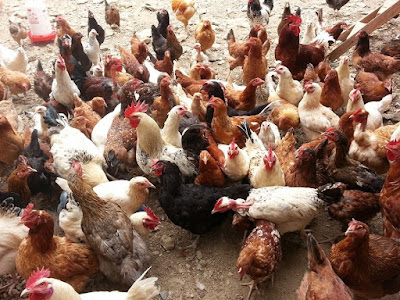
There has been an increasing buzz on raising of indigenous chickens around the country due to an increase on demand of road runner meat. Quite a number of people are exploring rearing of road runners using intensive systems of production to maximise their productive potential. Indigenous chicken production systems are mostly based on the local scavenging domestic fowl (Gallus domesticus), which predominates in African villages. Sometimes the productivity of these birds is very low, but with proper management practices indigenous chicken can become very productive and have a very good potential for improving the income of the owners. Local chicken breeds are the most abundant livestock species in Zimbabwe. Indigenous chicken are mostly kept under a free range system in small flocks of less than 30 birds. They are more adapted to local conditions than the hybrids but have a lower productivity. Breeding indigenous chicken for improvement of the breed is very feasible for the specialist.
SOME FACTS ABOUT INDIGENOUS CHICKENS
• Meat and eggs are tastier and preferred by most consumers to those obtained from commercial breeds
• Initial investment is less than that needed to keep commercial breeds
• More tolerant of harsh conditions, including diseases, than commercial breeds
• Can be fed on cheap, locally available feeds
• When allowed to range freely, they need little feeding or other care
• Women and youth often control income from chickens
• Droppings are rich in nutrients: can be used for compost making, pond fertilizing and as feed for livestock.
WHY IMPROVED MANAGEMENT?
• Survival rate of chicks can be increased from 30% to 80%.
• If you hatch your eggs and sell chicks, earnings can be much higher (up to 7-times higher) than if you simply sell the eggs.
• Simultaneous hatching of hens (so all chicks hatch at the same time) makes planning for vaccinations easier.
• By cooperating with neighbours, farmers with small flocks can access vaccines at more affordable rates.
• Planning your production to meet high seasonal demand – such as at Christmas, Easter and other festivals can greatly increase your profits.
• If hens are prevented from hatching their own eggs or brooding chicks, they will start to lay again more quickly – after just 21 days, instead of the usual three months.
THE REQUIREMENTS
• One cock for every 10 hens
• Water and feed containers
• Housing space
• Laying nests
• Carton box with ventilation holes
• Wood shavings, hay or wheat straw for bedding
• Vaccines and drug
SELECTING BREEDING STOCK
• Select a hen that is broody, does not abandon her eggs during hatching and looks after her chicks well.
• Select a healthy, strong cock.
HOUSING
Why should housing be provided?
Housing is necessary to protect chicken against predators, thieves, adverse weather (rain, sun, cold winds and low night temperatures) and to provide shelter for egg laying and broody hens. Suitable poultry houses are important for efficient production and management. Poultry houses and shelters vary depending on availability of materials, weather and tradition. Choice of chicken housing should be based on cost, durability and usage. Reserve one square metre per 10 – 12 adult birds.
THE IMPROVED MANAGEMENT PRACTICES
Feeding
• Provide a balanced diet. For example, a small handful of maize, a teaspoonful of fishmeal and some fresh greens, in addition to scavenged feeds like insects, will provide a good diet for one chicken in a day.
• Provide clean water at all times.
How to feed
| AGE | INTAKE PER BIRD |
| Day old to 8 weeks | 2kg during this phase |
| From 8 weeks to 16 weeks | 4.5kg during this phase |
| Up to 75 weeks | 125g per day |
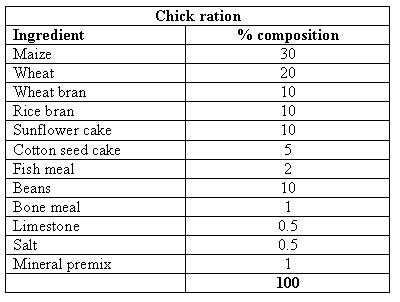
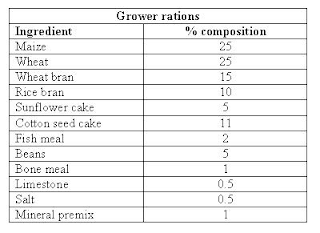
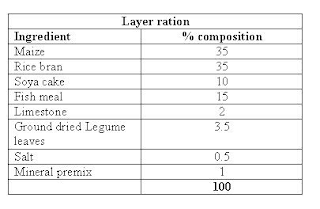
What to feed
Producers can formulate diets as below or purchase commercially available feeds.
Collecting the eggs
• Provide a safe, dry, dark place for the hens to lay.
• Collect eggs daily, write the date on the egg in pencil and store with the broad end facing upwards: this helps to ensure the embryo develops properly.
Hatching
• Use only eggs that were laid in the last 14 days.
• Hatch eggs using the mother hen, another broody hen, a (surrogate) duck or an incubator.
• For hens and ducks, make sure the number of eggs chosen for hatching corresponds to the bird’s body size – all eggs must fit under the bird (ducks can hold up to 35 eggs and turkeys up to 50).
• For synchronized hatching (all chicks hatch at the same time), delay the first hen that becomes broody by giving it just one egg to sit on while you wait for other hens to lay their clutches and become broody.
• For successive hatching (the hen or the surrogate duck sits on eggs for two consecutive clutches), chicks are removed when they hatch and replaced with new eggs.
• After hatching, dispose of egg shells, clean the nest and transfer chicks to a brooder.
• Turn the eggs regularly, especially when using an incubator.
Brooding
• Brood chicks using a mother hen, foster hen, a lantern, kerosene brooder, charcoal stove or charcoal placed in a metal container.
• If a foster hen is used, condition it for a day by giving it new chicks.
• Take care that chicks cannot get burned – cover charcoal stove or container, ensuring that there is no risk of fire.
Heat Sources
• Charcoal Mbaura – one half drum is enough for 500 chicks
• Kerosene lamps – one lamp for 50 chicks
• Electricity – one infra red lamp for 250 chicks
Brooder Preparation
Use hard boards to make a brooding ring of 60 cm height
Put at least 5 cm of clean dried grass/leaves (litter) on the floor inside the brooding ring
Start with a density of 50 chicks per metre square
A hover/cover should be provided about the brooder, to reduce heat wastage
Make space for feed and water feeding equipment inside the brooder ring
Rearing chicks
• Provide clean water at all times in shallow, clean troughs.
• Provide soft feeds like flour from cereals or tubers.
• Allow chicks to roam freely when they reach 3 or 4 weeks of age.
• Vaccinate chicks against Newcastle disease at 4 days of age.
Scavenging
In a free-range or semi-intensive poultry rearing system, adult hens and cocks ought to be given enough time and space for scavenging in the surroundings daily. The best time for scavenging is early morning and late afternoon when there are plenty of insects and less heat. Chicks below six weeks of age should be confined. Supplementary feeds should be offered in the morning and evening when the birds come back for the night. Ad libitum clean water should be provided in shady areas during the day to avoid heat stress.
Record keeping
Keeping good records will help you to assess whether or not you are making a profit.
| PROBLEM | CAUSE | ACTION |
| Newcastle disease causes many birds to die |
Local disease outbreak. Failure to vaccinate. |
Vaccinate at 4 days and again at 4 and 16 weeks of age.
If this is not done, vaccinate just before the dry season or immediately when neighbour’s birds are sick or dying. Follow vaccine manufacturer’s |
| Fowl pox (pimple head) | Local disease outbreak Failure to vaccinate |
Vaccinate through the wing web, preferably at 3 weeks of age or whenever there is a risk of the disease.
Follow vaccine manufacturer’s |
| Fleas, ticks and lice | Poor hygiene | Dust floor of house and nest boxes with an insect powder approved for use with Chickens. Follow manufacturer’s instructions. |
| Worms | Infection picked up from other birds | De-worm once during dry season and again at start of rains or when chickens look weak.
Give dewormer in drinking water for 1 week or as recommended by manufacturer or veterinary officer. |
| Blood in droppings | Coccidiosis, fowl typhoid or fowl cholera | Treat as advised by your local vet.
Provide clean feed and water troughs. |
| Chicks grow slowly, stay small, are weak and unhealthy looking | Inbreeding – that is breeding from closely related birds. | Change cocks every year. |
| Poor hatchability | Storing unclean eggs (dirty or bloody).
Using eggs older than 14 days. Breeding from poor quality hens and cocks. |
Provide clean, dry nest boxes.
Wipe eggs clean before storage. Write date on eggs before storage and hatch only those laid in the last 14 days. Select good quality breeding stock. |
Author: James Kabinda – a member of the Windmill Stockfeed Division
Graduate Trainee Student
(B Sc) Animal Production and Technology.
Cell: +263 774 225 873, +263 782 728 999